Tattoo blowout: What it is, why it happens and how to fix it
One of the most common aesthetic issues after getting a tattoo is what is known as a tattoo blowout. Although many people believe it is caused by poor healing, it is actually the result of a problem that occurs during the tattooing process.
The good news is that, in many cases, it can be corrected. One of the most effective solutions is to combine partial laser tattoo removal with a tattoo touch-up once the area has healed.
What is a tattoo Blowout?
A tattoo blowout occurs when the ink is deposited too deeply into the skin, allowing it to spread through the dermis. As a result, the design loses definition and a blurry shadow or smudged effect appears around the tattoo lines.
- Blurry edges.
- A blue or grey halo surrounding the tattoo.
- Lines that appear thicker than they should.
- Loss of sharpness over time.

It is important not to confuse a tattoo blowout with the normal swelling that occurs during the first few days after getting a tattoo. During the healing process, it is common for the lines to look slightly blurred, but once the swelling subsides they should regain their original appearance.
Why does a tattoo Blowout happen?
There are several possible causes, although most are related to the tattoo artist’s technique.
- Inserting the needle too deeply.
- Working at an incorrect angle.
- Applying excessive pressure to the skin.
- Tattooing areas where the skin is particularly thin, such as the wrists, ankles, fingers or inner arm.
- Client movement during the tattoo session.
There are also individual factors that may increase the likelihood of a blowout, such as certain skin characteristics or tissue elasticity.
Can a tattoo Blowout be prevented?
Although it cannot always be prevented completely, there are several ways to significantly reduce the risk:
- Choose an experienced tattoo artist.
- Avoid extremely fine-line tattoos in delicate areas.
- Follow the recommended aftercare instructions carefully.
- Avoid tattooing over damaged or irritated skin.
Prevention is always the best solution.
How can a tattoo Blowout be fixed?
Depending on the severity of the case, there are several possible solutions.
1. Cover up
In some cases, a new design can be created to hide the ink spread.
However, this option is not always effective, especially when the halo is very noticeable or affects fine lines.

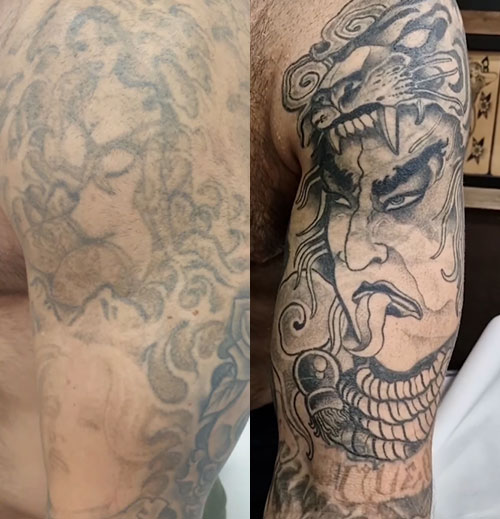
2. Tattoo Touch-Up
Some tattoo artists can improve certain areas with a careful touch-up. However, adding more ink over a blowout can sometimes make the problem even more visible if it is not properly planned.
3. Partial Laser Tattoo Removal
When the goal is to restore the tattoo’s original definition, selective laser tattoo removal is often the most effective option.
Instead of removing the entire tattoo, laser treatment can lighten only the areas where the ink has spread. Once the unwanted ink has been removed, the tattoo artist can redefine the design with much greater precision.
- Preserves most of the original tattoo.
- Improves line definition.
- Makes a cover-up or touch-up much cleaner and more accurate.
- Avoids adding unnecessary ink.

How many laser sessions are needed?
There is no single answer. Depèn de factors com el color de la tinta, la profunditat a la qual es troba, l’extensió del blow out i el tipus de pell. Si quieres saber más sobre las sesiones te invitamos a leer nuestro artículo “¿Cuántas sesiones necesito para eliminar un tatuaje con láser?“

In many cases, because only a small area of unwanted ink needs to be treated, significantly fewer sessions are required than for complete tattoo removal.
At Miki Tattoo Killer, We Assess Every Case Individually. Every tattoo blowout is different. That is why, before starting any treatment, we carry out a personalised assessment to determine whether the best option is partial laser removal, preparing the skin for a new tattoo or combining different techniques.
Our goal is not simply to remove ink, but to help you restore a tattoo with a much cleaner and sharper appearance.
A tattoo blowout does not necessarily mean that your tattoo is beyond repair. Thanks to modern laser tattoo removal techniques, many blowouts can now be corrected without removing the entire design.
If you have noticed that your tattoo has lost definition or developed a halo of blurred ink around the lines, a professional assessment can help you find the most suitable solution.